Traditional Karate
Weekly Newsletter • 7 February 2026
Weekly Update from Wadō-Ryū Benkyō
Hello, welcome to your 9th weekly update from Wadō-Ryū Benkyō. Below you’ll find this Saturday’s training notes, the latest long-format video, a featured article, course updates, and this week’s principle.
🥋 1. Saturday Benkyō Class Review – Today’s Training
🥋 Saturday Benkyō Class Review – Today’s Training
We began with a focused warm-up designed to prepare the body for the work ahead — not simply stretching or moving for its own sake, but freeing up the specific movements and mechanics needed for the class. From the start, the emphasis was on purpose and direction, aligning the body and mind with the training themes to follow.
Moving into Renraku Waza, the focus shifted toward fluidity and continuity. Rather than stopping between techniques, we explored how each movement creates the energy, position, and opportunity for the next. It became a real lesson in avoiding the habit of “killing” techniques through stop-start execution, and instead allowing principles such as Ryūsui and Dōsa to carry movement from beginning to end.
The remainder of the first hour centred on Seishan Kata, applying those same ideas of continuous motion and natural flow. The aim was not speed, but connection — allowing one technique to settle through Shizumu and naturally rebound into the next. Partner work reinforced this idea, showing how difficult it becomes to respond to fast, multiple attacks when movement stops and has to restart from zero. When techniques flow together, timing and response become far more natural.
We also explored what is often described as “hidden” within Seishan. Rather than secret techniques, it became clear that what is visible depends on experience and perspective. By looking closely at the hand movements, we found how they can be interpreted as multiple forms of uke — a reminder that depth often lies in plain sight.
The second hour moved into Naihanchi, using the kata as a vehicle to explore breathing — when it is used, why it is used, and how it connects to movement. Naihanchi provides an ideal framework for understanding how breath supports structure and continuity. Alongside this, we revisited Ōtsuka II’s philosophy of 1 + 1 + 1 = 1, exploring how separate elements of movement combine into a unified action unique to Wadō-Ryū. (video link.)
To bring everything together, we drilled the principle of Omomi through Kumite Kata 3 and 6, highlighting how heaviness only appears when Dōsa, Ryūsui, and Hadō work in harmony. The final ten minutes returned to Kihon 8, using it as a practical test of the day’s themes — continuity, settling, breathing, and connection.
By the end of the session there were tired bodies and busy minds — but that is exactly what Saturday Benkyō is about: deeper exploration, thoughtful practice, and leaving the dōjō with a little more understanding than when we arrived.
🎥 2. This Week’s Long-Format Video
Kihon Fundamentals Volume II - Keri Waza
with Roger Vickerman Renshi (7th Dan) and Kerry Moore Sensei (4th Dan)
In this extended volume of Kihon Fundamentals, Roger Vickerman Renshi and Kerry Moore Sensei continue the
systematic exploration of Wadō-Ryū Karate fundamentals, focusing entirely on Keri Waza
(kicking techniques) and the principles that allow them to function effectively within Wadō’s body mechanics.
Rather than treating kicks as isolated techniques, this session examines how keri waza must be integrated with
stance, posture, balance, timing, and body connection. Emphasis is placed on how the supporting leg, hips,
and centre contribute to stability and power, and how unnecessary tension or over-commitment undermines both
control and recovery.
Throughout the volume, kicks are explored as tools for positioning, disruption, and transition, not just as
striking actions. The discussion highlights common misunderstandings around kicking in Wadō-Ryū, particularly
the tendency to sacrifice structure or ma-ai in pursuit of height or force. Instead, the focus remains on
efficiency, recovery, and continuity, ensuring that each kick allows immediate movement into the next action.
This volume is particularly valuable for practitioners who want to move beyond treating kicks as “add-ons”
and instead understand how they function within Wadō-Ryū’s broader tactical and mechanical framework.
The material is relevant to kihon, kata, and kumite, and offers insight that applies equally to solo practice
and partner training.
As with all Kihon Fundamentals volumes, the aim is not to add complexity, but to remove what gets in the way,
allowing correct movement and power to emerge naturally.
Kihon Fundamentals – Keri Waza (Extended Volume)
Key areas explored include:
📝 3. Featured Article of the Week
Article: Chintō Kata — A Personal Exploration of Martial Strategy in Wadō-Ryū Karate
Chintō Kata — A Personal Exploration of Martial Strategy in Wadō-Ryū Karate
Chintō (鎮闘) is one of the most strategically rich kata in Wadō-Ryū, blending angled movement, sharp directional changes, vertical transitions, and subtle grappling concepts into a cohesive combative system. Rather than relying on rigid blocks or theatrical movement, the kata explores taisabaki (body management), meotode (paired-hand coordination), and practical applications such as throws, joint controls, and weight-shifting tactics. Rooted in both historical influence and evolving interpretation, Chintō encourages practitioners to move fluidly, adapt to changing force, and develop strategy through experience rather than imitation. This article looks beyond the outer choreography to reveal how Chintō embodies Wadō principles of evasion, blending, and intelligent positioning — making it a kata that rewards deeper study at every stage of training.
📅 4. Upcoming Courses, Events, or Updates
Things you may want to know about:
- The course and events calendar is now live on the website and will be updated regularly — please bookmark it and check it: Courses & Events.
- The May 2026 course dates and location have been confirmed — you can see all the details and book here: May 2026 Course.
- The August 2026 course is now also available for booking — full details here: August 2026 Course.
- The October 2026 course is now also available for booking — full details here: October 2026 Course.
- Saturday sessions will be running throughout February 2026 — except 21st February (Wadō Academy Winter Course). If you would like to attend a Saturday session for the first time, please get in touch.
🧠 5. Wadō-Ryū Principle of the Week
Omomi (重み) — Weight / Heaviness in Wadō-Ryū
· by Roger Vickerman Renshi (7th Dan) · Principles
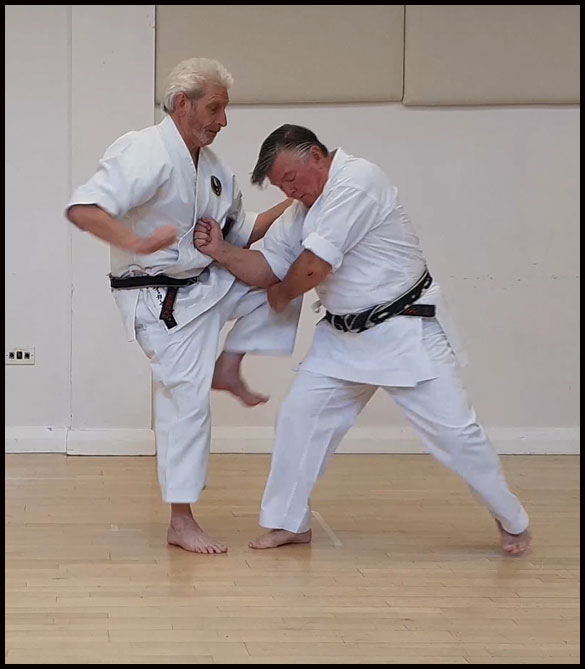
Omomi (重み) is the Wadō word for “weight” or “heaviness,” but it does not mean muscular strength. Omomi refers to the felt body mass behind a technique — the kind of impact where the opponent feels your whole body, not your arm. The strike lands heavy but calm, and the power penetrates rather than snaps.
This is exactly the type of heaviness Wadō aims for: dense, quiet, and unavoidable. It is not created by tensing the shoulder, stamping weight, or forcing a wide stance. It is created by correct timing, correct structure, and correct movement — so the body arrives as one unit.
What It Means to “Hit with Omomi”
In Wadō terms, when a senior says “hit with omomi,” they are pointing you toward a very specific quality:
- The opponent feels your whole body, not just the limb.
- The technique lands heavy but calm — no visible forcing.
- The power enters rather than “snaps” off the surface.
Omomi is not a separate trick you add on at the end — it is the natural result of the body being organised correctly.
How Omomi Works in Wadō-Ryū
Omomi is created by a combination of Wadō principles working together. Remove any one of them and the heaviness disappears:
- Shizumu (沈む) — settling of the centre so body mass can arrive.
- Hadō (波動) — wave transmission so force travels cleanly through the body.
- Dōsa (動作) — correct movement so the body arrives as one connected unit.
- Ryūsui (流水) — continuity without stopping, so technique does not “break” in delivery.
Omomi is the result of connected delivery. It is what happens when timing, posture, and movement align — and nothing unnecessary blocks the transmission.
What Omomi Is Not
- Omomi is not brute force.
- Omomi is not tensing the arm or shoulder.
- Omomi is not wide, rooted stances as a substitute for timing.
- Omomi is not stamping or dropping weight hard.
True omomi feels dense, quiet, and inevitable. It is heaviness that arrives naturally — not heaviness that is “put on.”
Where Omomi Is Most Evident
You’ll feel omomi most clearly in training that emphasises short-range structure and connected body delivery, such as:
- Naihanchi (short-range techniques and posture control)
- Kihon Kumite (especially numbers 3, 7, and 10 See videos examples below)
- Seishan close-range entries and finishing actions
- Body strikes, controls, and decisive close-range transitions
“It feels like being leaned on by the floor.”
Related Terms You May Also Hear
| Term | Meaning | Relation |
|---|---|---|
| Shizumu | Sinking / settling | Creates the condition for omomi to arrive |
| Jū (柔) | Softness / yielding | Allows omomi to enter without collision |
| Chikara | Strength | Not the goal in Wadō delivery |
| Kime | Focus / decisiveness | Secondary to omomi in Wadō (often confused with tension) |
In Simple Terms
Omomi is the heaviness of correct body mass arriving at the right moment. If you’re writing or teaching, “hit with omomi” is both technically accurate and very much Wadō language — because it describes the quality we are trying to produce, not just the technique we are performing.
Kihon Kumite Examples of Omomi
Below are short demonstrations from Kihon Kumite that highlight how omomi appears in Wadō-Ryū practice. Notice how the heaviness comes from timing, structure, and settling — not force.
Kihon Kumite 3
Kihon Kumite 7
Kihon Kumite 10
🙏 Thank You for Being Part of the Community
If you have any questions, video requests, or feedback, simply reply or get in touch — we read everything.
Wishing you a fantastic week of training,
Roger and The Team
Wadō-Ryū Benkyō